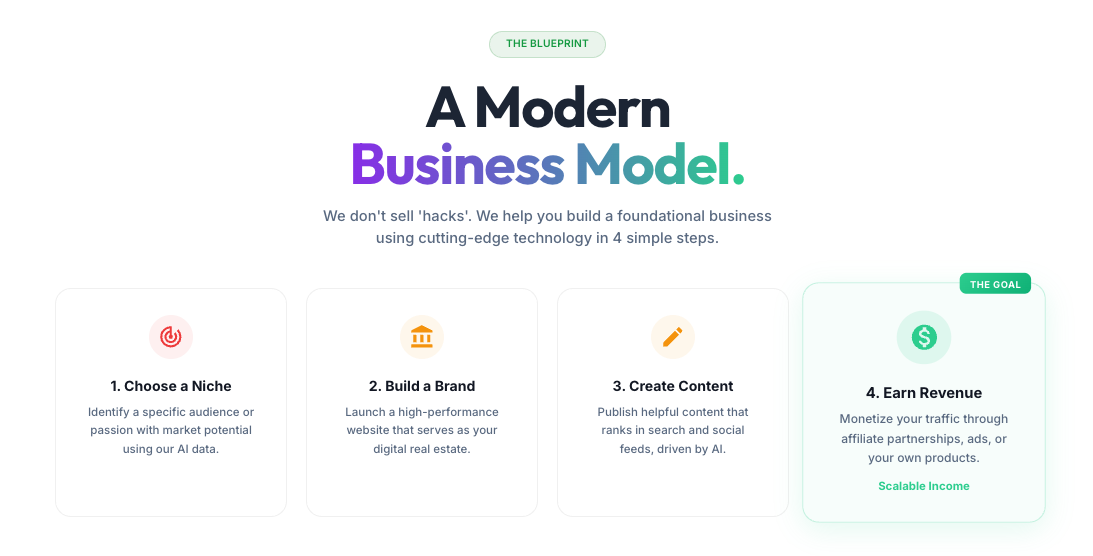
The four-step online business blueprint is simple: choose a niche, build your online presence, create helpful content, and turn that audience into revenue. AI can make the research, writing, design, and publishing process faster, but it does not replace consistency or genuinely helping people.
- The Business Model Hasn't Changed. The Barrier To Entry Has.
- Breaking Down the 4-Step Online Business Blueprint
- Why This Blueprint Still Works
- Common Mistakes New Online Business Owners Make
- Ready to Build an Online Business Instead of Chasing the Next Shortcut?
- Four-Step Online Business Blueprint FAQ
The Business Model Hasn’t Changed. The Barrier To Entry Has.
What excites me most isn’t AI itself.
It’s that someone starting today has access to tools that simply didn’t exist when I got started. Things that used to take weeks can now take hours. Tasks that once required hiring specialists can often be handled by one person with the right guidance.
That doesn’t make success automatic.
It just means you can spend more time building your business instead of fighting the technology.
And that’s exactly why I’ve stayed with Wealthy Affiliate.
Not because it’s a magic button.
Because it gives me one place to build websites, learn SEO, understand AI, create content, ask questions, and keep improving without trying to piece together ten different subscriptions.
I’ve spent money on shiny objects over the years. Most promised shortcuts.
Very few actually helped me build something that lasts.
Wealthy Affiliate has been different.
If you’re looking at this blueprint and thinking, “I understand the four steps…I just need someone to show me how to put them together,” that’s where I think Wealthy Affiliate shines.
👉 You can take a look here: Wealthy Affiliate
AI has not changed the basic online business model nearly as much as it has changed the barrier to entry. Jobs that once required several tools, outside specialists, or weeks of work can often be handled by one person much faster. The fundamentals, though, are still surprisingly familiar: pick a direction, build something useful, help people, and keep publishing.
They have a free Starter membership, so you can explore the platform before deciding whether it’s right for you. That’s one of the reasons I recommend it—there’s no pressure to pull out your credit card just to see what it’s all about.
Breaking Down the 4-Step Online Business Blueprint
The infographic gives you the big picture, but let’s slow down for a minute and look at what each step actually means. None of these steps are complicated on their own. The challenge is putting them together consistently.
One thing I’ve learned over the past few years is that AI hasn’t changed the blueprint. It has simply made each step faster and easier to manage.
Step 1: Choose Your Niche
Every successful online business starts with a specific audience.

A niche is simply the topic your website focuses on. Instead of trying to write about everything, you build your content around one area where people are already looking for answers.
That could be:
- Coffee
- Travel
- AI tools
- Affiliate marketing
- Fishing
- Home improvement
- Personal finance
The narrower your focus at the beginning, the easier it becomes for search engines—and readers—to understand what your website is about.
When I started building niche websites, I realized something important. You don’t need to know everything about your topic. You simply need to stay one or two steps ahead of the person searching for help.
Today, AI can speed this process up by helping you brainstorm ideas, organize categories, discover search questions, and even identify gaps in the competition. But the final decision still comes down to you. Pick something you’re willing to write about for years, not weeks.
Goal of Step 1: Choose a niche that has an audience, solves real problems, and keeps you interested enough to continue creating content.
| Step | What You Do | Primary Goal |
|---|---|---|
| 1. Choose a Niche | Select a specific audience and topic. | Create a clear focus for your business. |
| 2. Build a Website | Launch your website and establish your brand. | Create an online home you control. |
| 3. Create Helpful Content | Publish useful articles that answer real questions. | Build traffic and trust over time. |
| 4. Monetize | Recommend products or services that genuinely help readers. | Turn trust into long-term income. |

Step 2: Build Your Website
Once you know who you’re helping, you need a place to help them.
Your website is your online business headquarters.

Unlike social media, you own your website. You’re not relying on an algorithm that can change overnight, and your content doesn’t disappear after a few days.
A simple website is all you need to begin.
Start with:
- A memorable domain name
- Reliable hosting
- WordPress
- A clean, mobile-friendly theme
- Basic pages like About, Contact, Privacy Policy, and Affiliate Disclosure
Don’t spend weeks trying to make everything perfect.
One mistake I made early on was believing my website had to look amazing before publishing my first article. It didn’t. Readers care far more about finding useful information than they do about fancy graphics.
AI can help generate logos, create images, write page drafts, and even organize your site structure. Those tools save time, but your personality is still what makes the site memorable.
Goal of Step 2: Create a professional home for your content that visitors can trust.
Step 3: Create Helpful Content
This is where your business begins to grow.
Content is what brings visitors to your website through Google, social media, Pinterest, YouTube, or email.
Every article should answer a question, solve a problem, or help someone make a decision.
Instead of asking yourself:
“What should I write today?“
Ask:
“What is someone searching for that I can genuinely help them with?“
That’s the difference.
Helpful content might include:
- Tutorials
- Product reviews
- Comparisons
- Beginner guides
- Frequently asked questions
- Personal experiences
- Resource lists
AI has become one of my favorite tools during this stage because it helps organize ideas much faster. I use it for outlines, brainstorming, editing, headlines, meta descriptions, image prompts, and polishing rough drafts.
What I don’t do is copy AI output and publish it untouched.
The content still needs your experience, opinions, testing, screenshots, stories, and personality. That’s the part AI can’t replace.
Google is getting better every year at rewarding content that demonstrates real experience instead of simply repeating information already found on hundreds of other websites.
Goal of Step 3: Publish useful content consistently so people begin discovering and trusting your website.
Step 4: Monetize Your Traffic
Traffic alone doesn’t build a business.
Eventually, your content should connect readers with products or services that genuinely help solve their problem.
There are several ways to monetize a website:
- Affiliate marketing
- Display advertising
- Sponsored content
- Digital products
- Courses
- Memberships
- Coaching
- Selling physical products
Affiliate marketing remains my favorite because it’s simple.
If I write a detailed review of a tool I actually use, and someone decides it’s the right solution for them, I may earn a commission if they purchase through my affiliate link. They don’t pay anything extra, but my recommendation is rewarded.
The key word there is recommendation.
I never want readers to feel like every page is trying to sell them something. The content should provide value first. The affiliate links should feel like the natural next step—not the entire purpose of the article.
Ironically, that’s also what tends to convert the best.
AI can help here too by creating email campaigns, social media posts, comparison tables, product summaries, and content ideas. But trust still comes from honest recommendations backed by your own experience.
Goal of Step 4: Turn the trust you’ve built into sustainable income by recommending products and services that genuinely help your audience.
Why This Blueprint Still Works
The tools have changed dramatically over the past few years. But my advice is don’t get caught chasing every new AI tool that launches next week.
AI writes faster.
AI creates images.
AI speeds up research.
AI helps organize entire workflows.
But the business model itself hasn’t changed.
You still need to:
- Choose a niche.
- Build a website.
- Create genuinely helpful content.
- Monetize by helping people find the right solutions.
Everything else is simply making those four steps easier.
That’s why I still follow this blueprint today, and it’s the same process I’d recommend to anyone starting an online business from scratch. If you stay consistent with those fundamentals, you’ll always be building something that has value.
Common Mistakes New Online Business Owners Make
- Waiting until everything is perfect
- Choosing a niche that’s too broad
- Publishing inconsistent content
- Focusing on money before helping readers
- Depending only on social media instead of building a website
| Stage | Traditional Approach | Using AI Today |
|---|---|---|
| Research | Hours of manual searching and note taking. | Brainstorm ideas and organize research in minutes. |
| Website Setup | Design everything from scratch. | Generate branding ideas, layouts, and images faster. |
| Content Creation | Start every article with a blank page. | Create outlines, improve drafts, and generate visuals. |
| Marketing | Write emails and social posts one at a time. | Repurpose content across multiple platforms quickly. |
Ready to Build an Online Business Instead of Chasing the Next Shortcut?
Wealthy Affiliate combines hosting, website building, AI-powered tools, keyword research, training, and one of the most active online business communities I’ve ever been part of. It’s where I’ve continued to learn, adapt, and grow as AI has changed the way we build websites.
Start Free and See the Blueprint in PracticeExplore the platform and see whether it fits the business you want to build.
Four-Step Online Business Blueprint FAQ
A few straightforward answers about using AI to build an online business without getting distracted by every new tool or shortcut.
What are the four steps for building an online business?
The basic steps are to choose a niche, build an online presence, create helpful content, and develop ways to earn revenue from the audience you attract. Each step supports the next, so it is usually better to build them in order rather than trying to monetize before you have something useful to offer.
Can AI build an online business for me?
AI can help with research, brainstorming, outlines, writing, image creation, and repetitive technical work. It cannot choose your long-term direction, earn the trust of your audience, or stay consistent for you. Think of AI as a capable assistant rather than an automatic business.
Do I need technical experience to start?
No advanced technical experience is required to begin. Modern website builders, training platforms, and AI tools have made tasks such as setting up a website, researching topics, and creating content much more approachable. You will still need to learn the basics as your business grows.
How do I choose a profitable niche?
Look for an audience with identifiable questions, problems, interests, or buying decisions. A good niche should be focused enough that you know who you are helping, but broad enough to support plenty of useful articles, products, and future content.
How long does it take to make money online?
There is no guaranteed timeline. Results depend on the niche, competition, content quality, traffic strategy, and how consistently you work. AI may shorten the time required to complete individual tasks, but building trust, search visibility, and reliable revenue normally takes patience.
What is the biggest mistake beginners make?
One of the biggest mistakes is repeatedly changing tools, niches, or strategies before giving anything enough time to work. A simple plan followed consistently will usually take you further than chasing every new platform or promised shortcut.
How does Wealthy Affiliate fit into the blueprint?
Wealthy Affiliate brings website building, hosting, keyword research, training, AI-powered tools, and community support into one platform. It can help beginners understand how the separate pieces of the blueprint work together without assembling a large collection of unrelated services.