Social media can help people discover your art, understand your process, and decide whether they want to follow, buy, or work with you.
But you do not need to become an influencer. You do not need to post on every platform. You do not even need to post every day.
You need to show your work to the right people, give them a reason to care, and make it easy for them to take the next step.
That next step might be buying an original painting, ordering a print, booking a commission, visiting an exhibition, or joining your email list.
Here is how to market your art on social media without turning it into a second full-time job.
Quick answer: Choose one main platform where your audience spends time. Complete your profile, share finished artwork and creative process, explain the story behind your work, and guide interested people to your shop, portfolio, commission form, or email list. Track saves, shares, clicks, inquiries, and sales instead of focusing only on likes.
- Start With a Clear Goal
- Know Who You Want To Reach
- Ask Yourself These Questions
- Audience Examples
- Your Profile Should Answer Three Questions
- Your Profile Should Include
- Example Artist Bio
- Pin Your Most Important Posts
- Organize Your Profile Highlights
- Choose the Right Social Media Platforms
- A Simple Beginner Strategy
- Use Instagram to Show Your Work and Personality
- Use TikTok for Discovery and Process Videos
- Use Pinterest to Drive Long-Term Traffic
- Create Content Around Five Simple Themes
- Use a Simple Content Mix
- Write Captions That Add Context
- Use Search-Friendly Language
- Need Help Creating Social Media Content?
- Build Trust Through Real Engagement
- Build Better Engagement Habits
- Use Social Listening to Find Better Content Ideas
- Collaborate With Other Artists and Creators
- Make It Easy for People to Buy
- Track the Metrics That Matter
- Follow a Simple Weekly Schedule
- Avoid These Common Art Marketing Mistakes
- Remember Copyright, Disclosure, and Accessibility
- Make Your Content Easier to Access
- Frequently Asked Questions
- Final Thoughts
Start With a Clear Goal
Before you create a content calendar, decide what you want social media to do for your art business.
Your main goal could be to:
- Sell original artwork
- Sell prints or other products
- Book commissions
- Find illustration or design clients
- Promote exhibitions
- Attract galleries
- Grow an email list
- Build a loyal audience
- Teach art or sell courses
These goals can overlap. However, choosing one main goal will make your content much clearer.
For example, if you want to book commissions, your profile and posts should explain how commissions work. If you want to sell prints, your content should show the prints in real spaces and link directly to your shop.
Your call to action should match your goal.
| Goal | Useful call to action |
|---|---|
| Sell original artwork | View available artwork |
| Sell prints | Shop the print collection |
| Book commissions | Request a commission |
| Find illustration or design clients | View my portfolio |
| Promote an exhibition | Get event details |
| Attract galleries | View my artist portfolio |
| Grow an email list | Join my studio updates |
| Build a loyal audience | Follow for new work |
| Teach art or sell courses | Explore my classes |
A common mistake is trying to sell something in every post. Another mistake is never asking people to do anything.
Aim for a balance. Share useful and interesting content most of the time, then make clear offers when you have something to promote.
Know Who You Want To Reach
Knowing who you want to reach can make or break your social media marketing.
There is no point showing your work to random people if they have no interest in buying, sharing, or connecting with it.
Start by thinking about your most likely audience.
Ask Yourself These Questions
- What type of art do I create?
- Who would enjoy looking at this work?
- Who might buy it?
- Is the buyer decorating a home, buying a gift, or collecting art?
- What price range can they afford?
- What questions might stop them from buying?
- Where do they spend time online?
- What other artists, brands, or creators do they follow?
Your Audience Might Include
You do not need ten different customer profiles. Start with one main audience and one secondary audience. A clear focus will make your content easier to plan and your message easier to understand.
Audience Examples
Landscape Painter
A landscape painter may focus on homeowners, cabin owners, nature lovers, collectors, and people decorating a living room or office.
Portrait Artist
A portrait artist may focus on families, couples, pet owners, gift buyers, and people planning weddings or special events.
Digital Illustrator
A digital illustrator may focus on authors, game developers, publishers, small businesses, and content creators.
Once you understand your audience, your posts become easier to create. You know what topics to discuss, what examples to share, and what kind of language to use.
People should understand your account within a few seconds of visiting your profile.
Your profile should quickly explain what you create, who it is for, and what visitors should do next.
Your Profile Should Answer Three Questions
What do you create?
Who is it for?
What should visitors do next?
Your Profile Should Include
- A clear profile photo or recognizable artwork
- Your medium or specialty
- Your location, if local work matters
- A short description of your style
- A link to your website, shop, or portfolio
- A clear way to contact you
Example Artist Bio
Landscape painter creating quiet mountain scenes and cabin-inspired art. Original work, prints, and commissions available below.
Pin Your Most Important Posts
You should also pin a few important posts so new visitors can quickly understand your work and what you offer.
- An introduction to you and your work
- Your best example of finished artwork
- An explanation of your commission process
- A post showing available work
- A popular process video
Organize Your Profile Highlights
If the platform allows profile collections or Highlights, organize them around useful topics.
Do not make visitors dig through 300 posts to find out whether you sell anything. That is not a treasure hunt.
Choose the Right Social Media Platforms
Not every platform is a good fit for every artist.
The right platform depends on your artwork, audience, and goals. Choose the platforms where your ideal audience already spends time and where you can post consistently.
| Platform | Best use | Content ideas |
|---|---|---|
| Portfolio, community, branding, and sales | Reels, carousels, Stories, and finished artwork | |
| TikTok | Discovery and process content | Short videos, reveals, and studio clips |
| Search traffic and website visits | Vertical Pins, collections, and product images | |
| YouTube | Tutorials, stories, and deeper trust | Studio tours, process videos, and Shorts |
| Local groups, events, and communities | Live videos, groups, events, and Reels | |
| Behance or ArtStation | Professional portfolio work | Project breakdowns and case studies |
| Business and commercial clients | Client work, project posts, and case studies |
A Simple Beginner Strategy
Start with one main platform and one secondary platform.
Choose a combination that matches your goals and the type of content you enjoy creating.
You can add more platforms over time.
Launching on every platform at once often leads to inconsistent posts and a list of neglected accounts.
That is not a marketing strategy. It is just digital clutter.
Use Instagram to Show Your Work and Personality
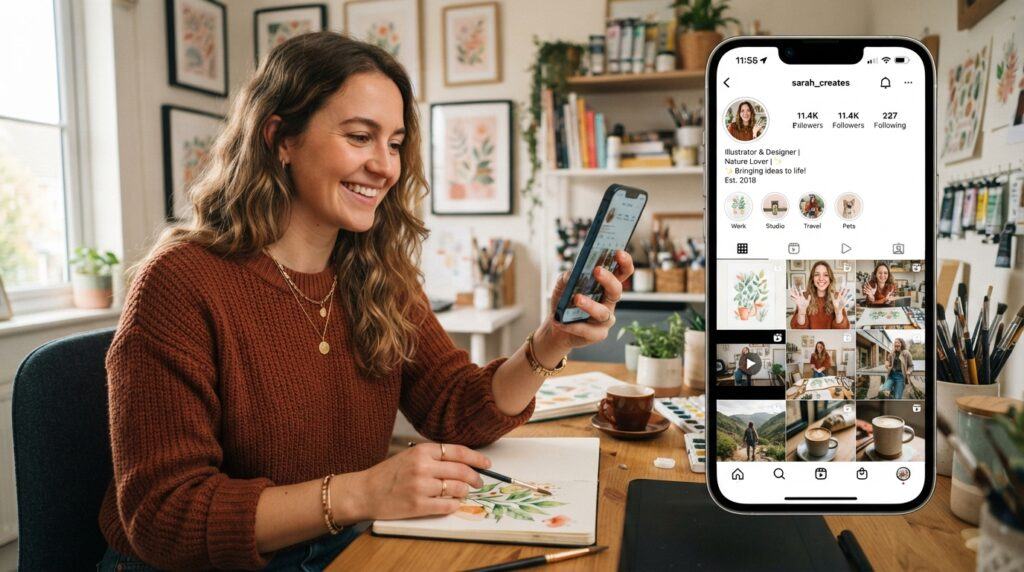
Instagram is a natural fit for visual artists because it gives you several ways to share your work.
Use:
- Reels for discovery
- Carousels for step-by-step content
- Stories for updates
- Feed posts for finished artwork
- Highlights for important information
- Profile links for your shop, portfolio, or email list
A finished image is useful, but it is only one type of content.
You can also show:
- A painting from sketch to final piece
- A close-up of texture
- Your workspace
- Your materials
- A mistake you fixed
- An artwork being packaged
- A piece hanging in a real room
- A customer receiving an order
Whenever possible, upload your original content directly to the platform. Avoid reposting videos with watermarks from another app.
You should also adjust the caption, opening line, crop, and call to action for Instagram instead of posting the exact same thing everywhere.
Use TikTok for Discovery and Process Videos
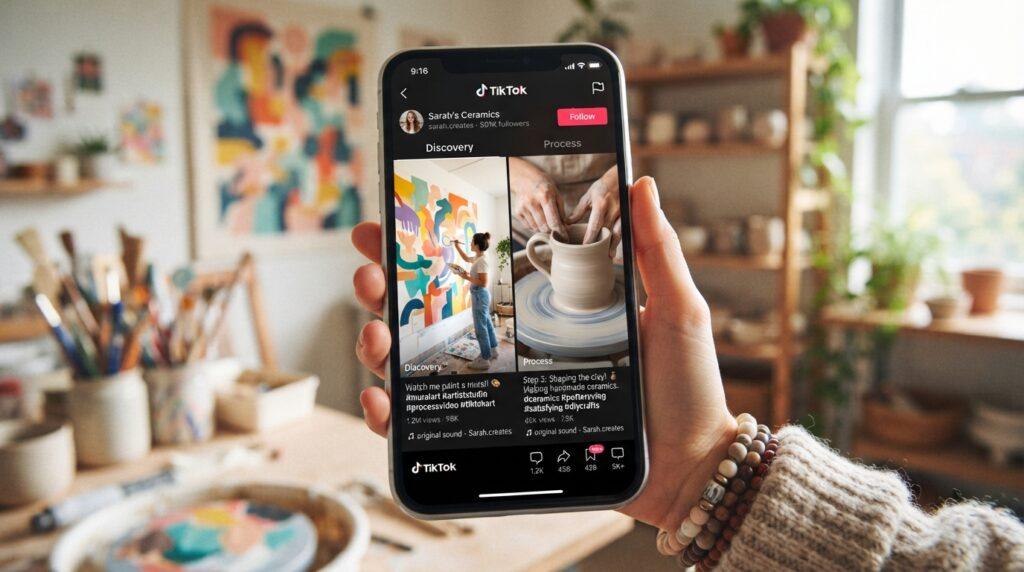
TikTok can work well for artists because people enjoy watching change happen.
You do not need an expensive camera setup. A phone, decent lighting, and a steady surface can be enough.
Try videos such as:
- A blank canvas becoming a finished painting
- A fast painting reveal
- A sketch turning into a digital illustration
- Preparing clay for a sculpture
- Packing an order
- Fixing an artwork that went wrong
- A close-up texture reveal
- A day in the studio
- Three things you learned while creating a piece
- Answering a follower’s question
You can also use TikTok search to find topics people are already looking for.
For example, if people search for how to frame watercolor paintings, create a short video answering that question.
If your video promotes artwork, products, services, or a brand partnership, pay attention to music and disclosure rules. Use music you have permission to use, especially for commercial content.
Use Pinterest to Drive Long-Term Traffic

Pinterest is useful for artists who want to send people to a website or shop.
It can work especially well for:
- Wall art
- Prints
- Home decor artwork
- Photography
- Wedding artwork
- Digital downloads
- Art tutorials
- Interior design inspiration
Pinterest content can continue sending visitors long after you publish it. That makes it different from a platform where a post may disappear from attention after a day or two.
Use clear words in your:
- Pin titles
- Pin descriptions
- Board names
- Profile description
- Website page titles
Instead of writing:
New art
Try:
Original mountain landscape painting for a cozy living room
That gives Pinterest and users more information.
Each Pin should link to the most relevant page. A Pin about a print should link to the print product page, not a random homepage.
Create Content Around Five Simple Themes
If you only post finished artwork, your account may start to feel like a silent catalog.
People want to see the work, but they also want to understand the person, story, and process behind it.
Build your content around five simple themes.
Finished Artwork
Show the completed piece clearly.
- The title
- The medium
- The size
- The inspiration
- Whether it is available
- Where people can learn more
You can also show the artwork in a realistic setting, such as a living room, office, gallery wall, or studio.
If you sell wall art, show scale whenever possible. A buyer may love a piece but still wonder whether it will look too small above their sofa.
The Creative Process
Process content helps people understand the time and skill behind your work.
- Sketches
- Color choices
- Materials
- Layers
- Tools
- Work-in-progress images
- Time-lapse videos
- Studio clips
- Mistakes and corrections
- Packaging and shipping
This painting started with three colors and a very questionable first layer.
That is more interesting than simply writing, “New painting.”
Your Story and Inspiration
Every piece has a story, even if the story is simply, “I liked the way the light looked that morning.”
- Where the idea came from
- What inspired the colors
- Why you chose the subject
- What the artwork means to you
- How the piece changed during the process
- What you learned while creating it
People often connect with the meaning behind the work before they are ready to buy it.
Helpful or Educational Content
Educational posts can attract people who are not familiar with your work yet.
- How to choose art for a room
- How to care for a painting
- The difference between an original and a print
- How your commission process works
- How to choose the right artwork size
- How you photograph your art
- What materials you use
- How long a piece takes to create
These posts can also answer questions that often stop people from buying.
Promotions and Social Proof
You should promote your work. You are allowed to tell people that something is available.
- New artwork
- Print releases
- Commission openings
- Exhibition dates
- Limited collections
- Customer reviews
- Photos from customers
- Sold artwork
- Press mentions
- Collaborations
If you share a customer’s photo or testimonial, ask for permission first.
Social proof helps reduce uncertainty. A potential buyer may feel more comfortable when they see that other people have purchased your work and had a good experience.
Use a Simple Content Mix
You do not need a perfect formula, but this is a useful starting point:
This does not mean you should hide your products. It simply prevents your account from becoming one long sales pitch.
A healthy mix gives people different reasons to follow you.
They may follow for the artwork, stay for the process, connect with your story, and eventually become a customer.
Write Captions That Add Context
Your image catches attention. Your caption gives people a reason to stay.
A simple caption structure is:
- Start with an interesting opening.
- Explain the artwork or process.
- Add one personal detail.
- End with one clear question or action.
Example Caption
I nearly abandoned this painting halfway through. The colors looked flat, so I added a darker layer around the edges and brought the light back into the center.
The finished piece is now available as an original and a limited print. Would you choose the original or the print?
Try to avoid vague questions such as:
- What do you think?
Ask something more specific:
- Which color would you have chosen?
- Do you prefer the sketch or the final version?
- Would you hang this in a bedroom or living room?
- Should I show more of the painting process?
- What type of artwork would you like to see next?
Specific questions usually create better conversations.
Use Search-Friendly Language
Social media platforms are also search tools.
Use natural phrases that describe your artwork, such as:
- Original landscape painting
- Handmade ceramic artwork
- Digital portrait commission
- Abstract art for modern interiors
- Watercolor illustration
- Mountain cabin wall art
- Custom pet portrait
- Local wedding photographer
Include these phrases naturally in your:
- Profile
- Captions
- Video descriptions
- Pin titles
- Board names
- Alt text
- Website pages
Do not stuff your captions with dozens of keywords or hashtags. Write for real people first.
Need Help Creating Social Media Content?
Coming up with fresh content for every platform can become exhausting, especially when you would rather spend your time creating art.
Kre8or AI can help you brainstorm social media content for your artwork, studio, products, and creative services.
- Generate social media post ideas
- Create caption ideas for your artwork
- Find different ways to promote a new piece
- Turn one idea into content for several platforms
- Brainstorm posts about your creative process
- Create promotional ideas for prints or commissions
It can be useful when you know you should post but have no idea what to say. You still provide the creative direction, artwork, and personal voice. Kre8or simply helps you get from a blank page to a usable idea faster.
Disclosure: This is an affiliate or invite link. If you join through this link, I may receive a commission or referral benefit at no extra cost to you.
Build Trust Through Real Engagement
Engagement is more than collecting likes.
It means creating real connections with people who care about your work.
Build Better Engagement Habits
- Reply to comments with real answers
- Thank people who share your work
- Ask followers for opinions during the process
- Use polls in Stories
- Answer direct messages professionally
- Comment on relevant accounts
- Give credit when sharing another artist’s work
- Collaborate with artists who serve a similar audience
- Share customer photos with permission
- Host live studio visits or question-and-answer sessions
Try Simple Community Activities
You can also run simple community activities that invite people to take part in your creative process.
- A color challenge
- A sketch prompt
- A “choose the next subject” poll
- A live painting session
- A virtual studio tour
- A question box about your creative process
The goal is to let people feel involved without allowing social media to take over your entire life.
Use Social Listening to Find Better Content Ideas
Social listening sounds more complicated than it is.
It simply means paying attention to the conversations happening around your art, your audience, and other artists in your niche.
Search for:
- Your art medium
- Your style
- Your location
- Common customer questions
- Other artists in your niche
- Topics people repeatedly discuss
Look for patterns.
If people often ask how to frame prints, create a post about framing.
If they ask how commissions work, create a simple guide.
If they are confused about the difference between original art and prints, explain it.
Your audience is often handing you content ideas. You just need to pay attention.
Collaborate With Other Artists and Creators
A good collaboration can introduce your work to people who already enjoy similar content.
Possible Partners Include
- Other artists
- Interior designers
- Home decor creators
- Photographers
- Local businesses
- Art supply companies
- Galleries
- Craft creators
- Writers and authors
- Event planners
Collaboration Ideas
- A joint live session
- A studio visit
- A shared giveaway
- A room makeover featuring your artwork
- A product bundle
- A joint creative challenge
- A conversation about your creative process
Choose partners based on audience fit, not just follower count.
An account with 3,000 interested followers may be more useful than one with 100,000 people who have no interest in art.
Make It Easy for People to Buy
Followers are helpful, but they are not the business.
If your goal is to sell art, your social profile should lead people somewhere useful.
Create Clear Destinations For:
- Original artwork
- Prints
- Commissions
- Portfolio work
- Exhibition information
- Email signup
- Contact details
Product Pages Should Explain:
- The artwork title
- Medium
- Size
- Price
- Availability
- Framing details
- Shipping information
- Processing time
- Return policy
- How to ask questions
Do not make people send you three messages just to find out how much a painting costs. Clear information builds trust.
A website also gives you more control.
If you want to create supporting social content more quickly, the Social Post Generator can help you turn one idea into several caption options.
You can also explore Kre8or AI for social media content if you need help creating branded visual posts.
Track the Metrics That Matter
Likes can be encouraging, but they do not tell the whole story.
The right metric depends on your goal.
| Goal | Metrics to watch |
|---|---|
| Reach new people | Non-follower reach, views, and watch time |
| Improve content | Saves, shares, comments, and video completion |
| Build relationships | Comments, replies, and direct messages |
| Grow interest | Profile visits, follows, and email signups |
| Sell artwork | Product views, inquiries, add-to-cart actions, and sales |
| Find clients | Portfolio clicks, contact forms, and qualified messages |
Review your analytics once a week.
Ask yourself:
- Which posts reached people who do not follow me?
- Which posts earned saves and shares?
- Which videos kept people watching?
- Which posts led to profile visits?
- Which links received clicks?
- Did any post lead to a sale or inquiry?
- What topic should I repeat?
Do not change your whole strategy after one post performs poorly. Social media data becomes more useful when you look for patterns over several weeks.
Follow a Simple Weekly Schedule
You do not need to post seven times a week to be taken seriously.
A simple starting schedule could look like this:
| Day | Content |
|---|---|
| Monday | Finished artwork with its story |
| Wednesday | Process Reel or short video |
| Friday | Carousel showing details, tips, or inspiration |
| Saturday | Available work, commission update, or shop reminder |
| Several days | Stories showing studio life or progress |
You can also turn one artwork into several pieces of content:
- A finished image
- A process video
- A close-up detail
- A carousel
- A Story poll
- A Pinterest Pin
- An email update
- A short blog post
This is called repurposing.
It does not mean copying and pasting the same post everywhere. It means adapting one idea to fit different platforms.
For example:
- Use a short reveal video on TikTok.
- Use a more polished Reel on Instagram.
- Use a vertical Pin linking to the shop.
- Use a longer process explanation on YouTube.
- Use a finished image and story in your email newsletter.
Avoid These Common Art Marketing Mistakes
Most art marketing mistakes are easy to avoid once you know what to watch for. Use the suggestions below to make your social media more useful, professional, and easier to manage.
Posting Only Finished Artwork
Finished pieces matter, but process content helps people connect with your work.
Trying to Manage Every Platform
Start with one or two platforms. Consistency beats being everywhere badly.
Copying the Exact Same Post Everywhere
Adjust the format, caption, opening line, and call to action for each platform.
Posting Videos With Another Platform’s Watermark
Upload a clean version whenever possible.
Buying Followers
Fake followers do not buy art, respond to your posts, or help you build a real community.
Using Vague Captions
Give people a story, detail, opinion, or useful piece of information.
Ignoring Comments and Messages
If someone takes time to interact with your work, respond like a real person.
Selling in Every Post
Your audience does not want to be chased around the internet with a cash register.
Never Making an Offer
The opposite mistake is also common. If your work is available, tell people how to buy it.
Sending People to a Confusing Website
Make sure your website is easy to navigate on a phone. Visitors should quickly find your artwork, prices, contact details, and buying instructions.
Using Copyrighted Content Without Permission
This includes music, photographs, artwork, and video clips made by someone else.
Giving credit is helpful, but credit does not always equal permission.
Focusing Only on Likes
Profile visits, saves, shares, clicks, inquiries, and sales may tell you much more.
Remember Copyright, Disclosure, and Accessibility
Artists should only post work they own or have permission to use.
Be careful when sharing music, stock images, photographs, artwork, or video clips made by someone else.
Disclose Commercial Relationships
If you receive payment, free products, discounts, or affiliate commissions, clearly disclose that relationship.
Simple language such as these examples is easy to understand:
- Sponsored
- Paid partnership
- This post contains affiliate links
Make Your Content Easier to Access
Small changes can make your content easier for more people to understand and enjoy.
- Add captions to videos
- Use readable text
- Avoid placing important information only inside an image
- Add useful alt text to website images
- Describe meaningful images clearly
- Mark decorative images as decorative
Example of Useful Alt Text
Original watercolor painting of a quiet mountain cabin beside a lake at sunset.
Do not turn alt text into a pile of keywords. Describe the image for someone who cannot see it.
Frequently Asked Questions
What is the best social media platform for artists?
Instagram is a strong starting point for many visual artists because it works well as a portfolio and community platform.
TikTok can help with discovery, Pinterest can send traffic to your website, and YouTube can help you build deeper trust.
The best platform is the one where your audience spends time and where you can post consistently.
How often should artists post on social media?
Start with three or four main posts each week, plus occasional Stories.
You can post more often if you have the time and energy. However, a schedule you can maintain is more useful than an ambitious plan you abandon after two weeks.
What should artists post besides finished artwork?
Share your process, sketches, studio, materials, mistakes, inspiration, educational tips, customer photos, exhibitions, and available work.
People enjoy seeing how the artwork develops.
How do artists sell art through social media?
Use social media to attract attention and build trust. Then send interested people to a product page, portfolio, commission form, shop, or email list.
Make the next step clear.
Should artists use hashtags?
A few relevant hashtags may help, but they should not be your entire strategy.
Use clear words in your profile, captions, video descriptions, Pin titles, and website pages.
Do artists need a website?
You can begin without one, but a website gives you more control over your portfolio, shop, email list, and customer experience.
It also gives people one reliable place to learn more about your work.
Final Thoughts
Marketing your art through social media is not about posting constantly or trying to please every algorithm.
It is about showing the right work to the right people, explaining the story behind it, and building enough trust for them to take the next step.
Choose one main platform. Create a mix of finished artwork, process content, stories, education, and promotions.
Respond to people like real people. Watch your analytics. Improve one small thing at a time.
Most importantly, remember that your artwork does not have to compete with everything online.
It only needs to reach the people who are looking for something like it.