Copyright Concerns With AI-Generated Content (What Creators Should Watch in 2026)
If you use AI to write posts, make images, or build ads, copyright questions show up fast. In my experience, they pop up in two places: what the model was trained on, and whether your final output looks too close to somebody else’s work.
Here’s the annoying part. Platforms and clients often treat you as the publisher of record, even if a tool produced the first draft. So the safest path usually looks boring: clarity, permission, and a simple repeatable process.
What copyright law cares about when AI is involved
Copyright still looks for human authorship. In plain English, it protects human creative choices, not button-clicking.
That’s why prompts alone usually don’t equal ownership. The U.S. Copyright Office has said you can’t claim copyright in raw AI output if the system controls the expressive parts. However, you can often protect your contribution, like substantial editing, rewriting, or a creative selection and arrangement of AI-assisted parts.
If you ever register something, you may need to disclose AI-generated material and only claim the human-made parts. That sounds strict, but it’s also a practical guide for creators: make real decisions, then document them. For more background on using AI without losing your voice, see what is content creation AI.
Prompting is cheap, ownership is the hard part
A simple prompt plus a pretty output can feel like “no one owns it.” That’s a problem when money is involved. For example, an image that was fine for organic social might get rejected when you reuse it in a paid ad, because the review bar is higher.
The safest mindset, you own what you change and control
Rule of thumb: the more you direct, edit, combine, and decide, the stronger your claim to the human portion. Keep a quick record, versions, notes, screenshots, or even a short changelog. It feels extra, until you need it.
The training data problem, you can’t see what the model learned

A lot of lawsuits focus on whether AI companies copied copyrighted works to build training sets. As of early February 2026, the U.S. has seen about 80 AI copyright cases, and the results aren’t perfectly consistent.
Courts also look hard at market harm and whether training replaces a real licensing market. In Thomson Reuters v. Ross Intelligence, the court sided with Reuters, rejecting fair use when the copying helped build a competing product. Meanwhile, Bartz v. Anthropic had a mixed outcome (training use viewed as transformative fair use in part), and it later settled. Another books case, Kadrey v. Meta, also favored fair use on the training question.
You’ll hear talk about “new rules” in states like California, but as of Feb 2026, there isn’t a clear statewide law forcing dataset posting. Policies still change fast, though, so tool terms matter.
Why “fair use” isn’t a free pass for AI training
Fair use is judged case-by-case, and “it’s AI” doesn’t automatically excuse copying.
If the AI use undercuts the original’s market, risk goes up.
If you’re using AI at work, ask these two questions first
- Is the provider clear about sourcing or licensing training data, and do the terms cover your exact use (ads, client work, reselling, etc.)?
- Does the tool store prompts or files, and could that expose private or client info? Put AI language in contracts, including “don’t upload confidential data,” and spell out who owns deliverables.
How to lower your risk when publishing AI-generated text or images
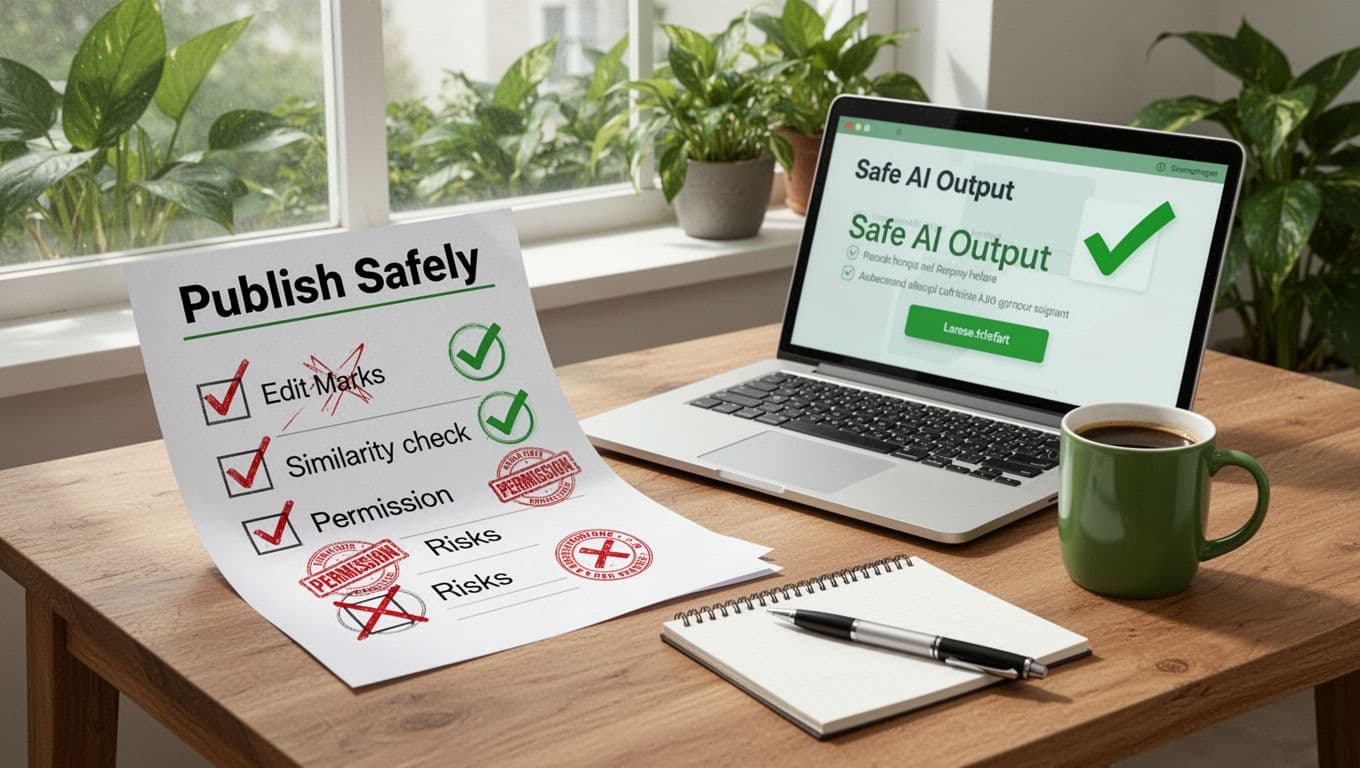
For a small blog or affiliate site, keep it simple. Avoid “in the style of” living artists, skip famous characters, and don’t chase brand lookalikes. Also, run quick similarity checks and keep proof of your edits. If other people contributed (photos, drafts, prompts, assets), get permission.
Brand risk is real too. AI visuals can drift and quietly weaken a carefully built identity. When possible, build a tagged library of your own assets and only train or fine-tune on materials you’re allowed to use.
Simple checks before you hit publish
- Did I edit enough that it sounds like me?
- Did I avoid living-artist style prompts and protected characters?
- Does anything look like a brand clone or logo mimic?
- Did I do a quick similarity scan (text or image)?
- Could this replace the original in the market?
- Would I feel okay explaining how I made this to a client or platform?
A smarter long-term play, build on content you actually control
Start a mini “rights-clean” library: your writing, your photos, paid-up licensed stock, and brand-approved graphics. Tag it by topic and use it as your base. Over time, that cleaner chain of rights can also open doors to licensing your own assets later.
What This Means Before You Publish
Copyright concerns with AI-generated content come down to three things: human control (for ownership), training data uncertainty (for upstream risk), and market harm (what courts keep circling back to). Pick tools with clear terms, don’t imitate protected work, document your edits, and ask permission when someone else’s content is involved. Rules keep shifting, so it’s smart to re-check tool policies every few months.