There was a time when you could throw almost anything at Google and watch it rank.
Three hundred words stitched together from recycled advice.
Ten affiliate links crammed into a paragraph like sardines in a can.
A headline promising “life-changing secrets” followed by content that felt like it was written by a malfunctioning toaster.
And for a while, somehow, that garbage worked.
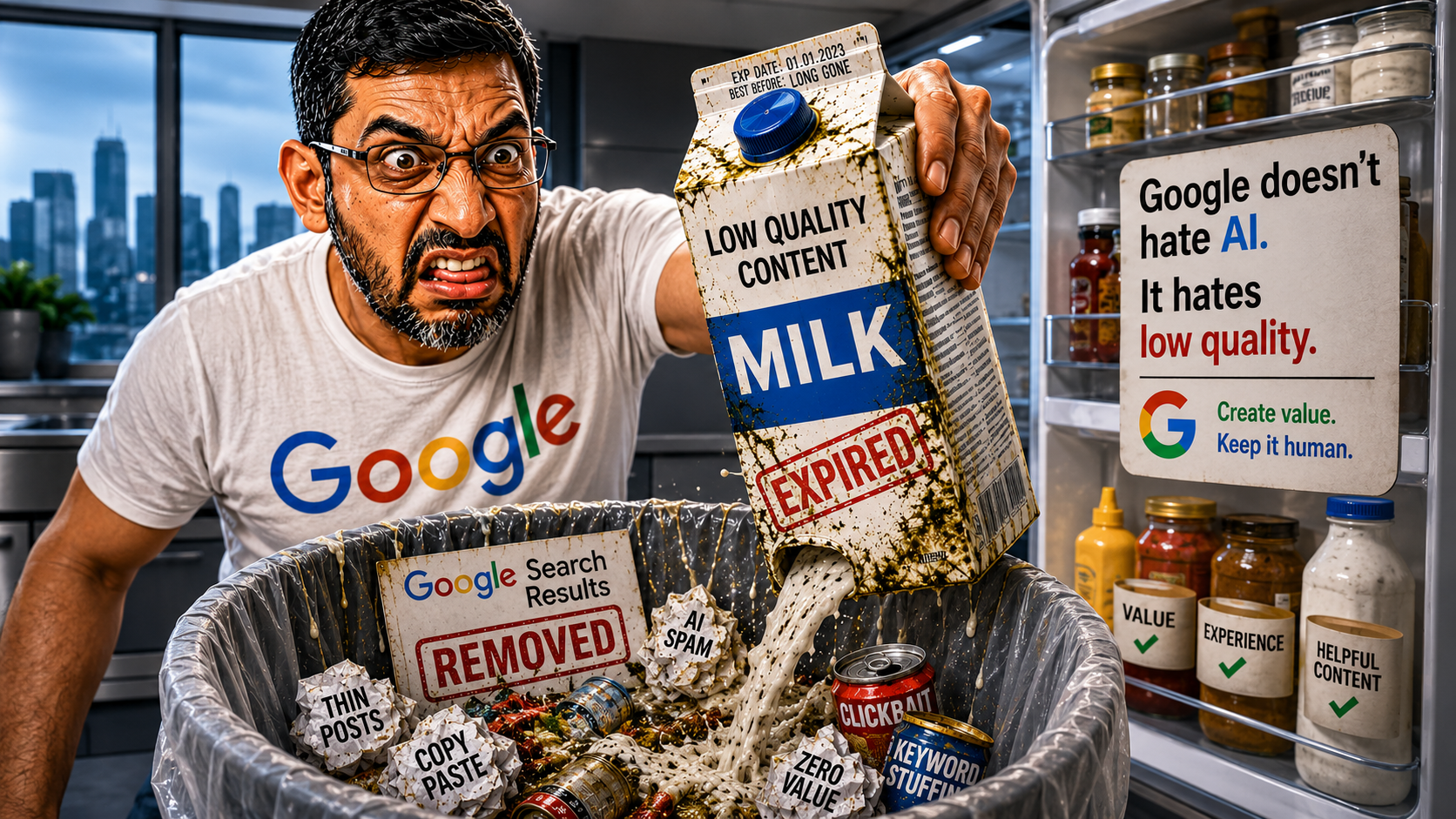
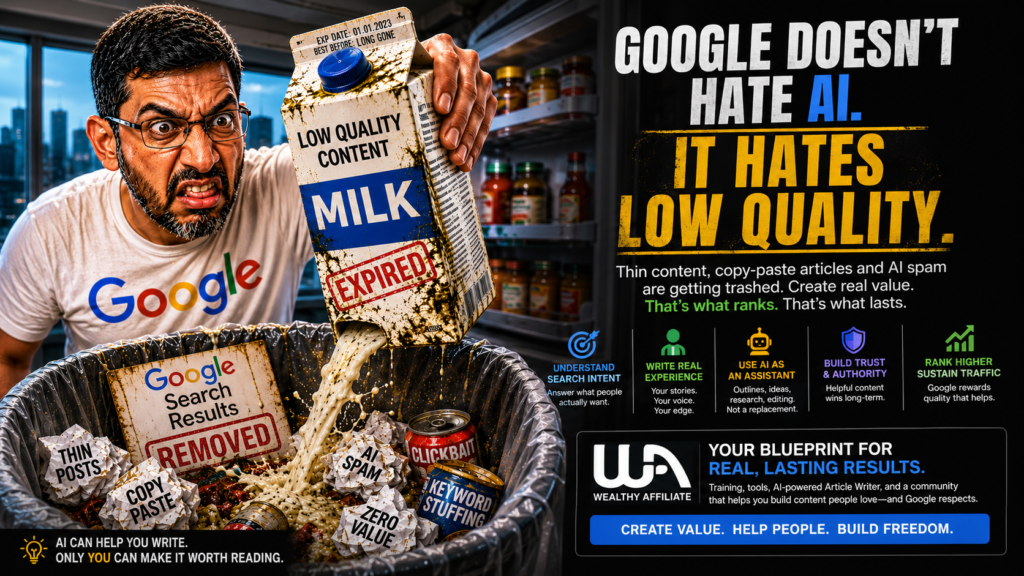
That’s what makes this image funny to me. Google standing there with the face of somebody who just opened a forgotten carton of milk from three months ago. Pure disgust. Immediate regret. One hand already reaching for the trash can.
Because that’s basically what’s happening now.
Low quality content is starting to rot in public.
Low Quality Content Is Starting to Rot in Public
You can feel it in search results. Pages that used to rank suddenly vanish. Sites built entirely on mass-produced filler start bleeding traffic. Entire businesses built on copy-and-paste publishing are discovering that algorithms eventually learn the smell of expired content.
The strange thing is people keep blaming AI for this mess.
AI Didn’t Create Lazy Content

AI didn’t create lazy content.
Lazy people created lazy content. AI just made it faster.
And that’s the part nobody wants to admit.
Some creators are treating AI like a slot machine. Pull the handle. Generate 5,000 words. Publish instantly. Repeat until traffic magically appears.
No editing.
No experience.
No opinion.
No personality.
No human fingerprints anywhere on the page.
Just digital oatmeal poured into the internet at industrial speed.
💡 Did You Know?
Google’s Helpful Content systems are designed to identify content that feels created primarily for rankings instead of helping actual people.
That means mass-produced AI articles with no experience, no originality, and no human insight can eventually become invisible in search results, even if they technically “answer” a question.
The pages that still tend to survive are the ones with personality, real-world experience, helpful examples, honest opinions, and clear signs that an actual human cared enough to shape the final result.
Then they wonder why readers bounce faster than a cat hearing a vacuum cleaner start up.
The Problem Was Never the Tool
The problem was never the tool.
The problem is people trying to remove themselves from the process entirely.
That’s why I still think platforms like Wealthy Affiliate matter more now than they did a few years ago.
Not because they hand people magic success pills. Anybody selling that fantasy should probably be standing beside this trash can, too.
What Wealthy Affiliate actually does well is teach structure. Search intent. Audience understanding. Topic building. Long-term thinking. The boring stuff most people skip because they want overnight traffic and beach photos by Thursday afternoon.
And honestly, that foundation matters more today because AI exists.
Without strategy, AI turns into the static between radio stations.
With strategy, AI becomes a serious assistant and a valued member of your team.
The Article Writer inside Wealthy Affiliate is a good example of that balance. It helps break through writer’s block. It helps organize ideas when your brain feels like scrambled eggs after staring at analytics for four hours. It speeds up research. It helps you build momentum.
But it still needs a driver.
It still needs somebody with actual thoughts.
Helpful Content Still Needs a Human Voice

That human layer changes everything.
- Your personal experiences.
- Your failures.
- Your humor.
- Your frustrations.
- Your stories.
- Your weird opinions about why half the internet sounds like corporate soup now.
That’s the kind of stuff that readers both value and tend to remember.
Google Wants Useful Content Again
And honestly, Google seems hungry for that again.
Not polished perfection.
Not robotic “ultimate guides.”
Not articles stuffed with keywords like somebody lost control of a seasoning shaker.
Just useful content written by somebody who clearly gives a damn.
That doesn’t mean AI goes away. It means AI becomes part of the kitchen instead of trying to replace the cook.
Because the internet already has enough expired milk.
Frequently Asked Questions
Does Google hate AI-generated content?
No. Google has repeatedly said it focuses more on content quality than how the content was created. The real issue is low quality publishing. Articles that feel generic, recycled, shallow, or created only to manipulate rankings tend to struggle over time.
Why are some AI-written articles losing rankings?
Many AI-generated articles fail because they lack experience, originality, and human insight. Publishing large amounts of repetitive content without editing, research, or personality can create pages that readers quickly abandon and search engines stop trusting.
Can AI still help with content creation?
Absolutely. AI can help generate outlines, organize ideas, speed up research, and break through writer’s block. The strongest content usually comes from combining AI efficiency with human editing, personal experience, and original thinking.
What makes content feel more human?
Readers tend to connect with stories, opinions, examples, humor, mistakes, and practical experience. Content feels more authentic when it sounds like it came from someone who actually understands the topic instead of a machine stitching together predictions.
How does Wealthy Affiliate help content creators?
Wealthy Affiliate focuses on teaching search intent, audience understanding, niche building, and long-term content strategy. Its tools, including the AI-powered Article Writer, are designed to support creators without replacing the human voice that makes content trustworthy.